
Have you ever wondered if cybersecurity is really worth it as a career? That is a fair question to ask before you spend your time and energy on it. Nobody wants to spend months learning a new skill only to find the pay does not match the effort. The good news is that the cybersecurity salary in India tells a genuinely encouraging story right now, and knowing why can help you plan your next move with real confidence instead of just guessing.
The size of this opportunity is hard to ignore. India’s internet user base has crossed 900 million people, and every one of those users, along with the businesses serving them, needs protecting. At the same time, the country is short by nearly 790,000 skilled cybersecurity workers, a gap that grew more than 40% in a single year according to ISC2’s most recently published workforce study. When this much demand meets this little supply, pay only moves in one direction, up. So, before we get to the numbers, let us look at what actually shapes them, starting with the job roles themselves.
What Defines a High Cybersecurity Average Salary in India?
Not all cybersecurity jobs pay the same, and understanding why is the first step in planning your own path. A simple way to see this is to compare a fresh graduate’s pay with a senior leader. Security Analysts, often the first step into the field, typically earn between ₹40,000 and ₹70,000 a month watching systems and applying basic safety rules. Network Security Engineers, who protect a company using firewalls and VPNs, generally earn ₹4–8 lakhs a year. Move up to Security Architects, who design entire network defence systems, and pay climbs to ₹17–22 lakhs, while Chief Information Security Officers average around ₹23 lakhs, with some top leaders crossing ₹30 lakhs.
This spread is exactly why the cybersecurity average salary in India is best seen as a range shaped by your specialisation, not one fixed number. Cloud Security is a good example of how specialising pays off. These roles often start around ₹8 lakhs and rise fast as more Indian companies move to AWS, Azure, and GCP, with cloud-focused professionals earning 30% to 50% more than the baseline. To put this in perspective, Glassdoor data shows the average cybersecurity analyst salary in India sits near ₹5.5. That gap alone shows how much the market values this skill. But roles are only half the story, where you sit on the experience ladder changes everything too.
Benchmarking the Google Cybersecurity Salary Potential
For many, the biggest problem is not ambition but access, how do you get in without years of experience already behind you?
This is where global, beginner-friendly programs matter, and it helps to understand the google cybersecurity salary story to see why. Google’s Cybersecurity Professional Certificate was built specifically for people with zero prior experience, teaching hands-on skills in Python, Linux, SQL, and SIEM tools over about 6 months of part-time study and graduates use it to enter the field from a stronger starting point than they otherwise would.
What makes this path valuable for Indian learners is what it stands for, proof that real, practical skills can make up for years of formal experience when you are just starting out. It also pairs well with CompTIA Security+, one of the most widely known entry-level certifications, giving freshers 2 credentials to open doors with. Employers looking at a fresher’s readiness tend to view this combination well, since it shows hands-on ability. If you have ever felt unsure whether you belong in this field, this combination is genuinely encouraging. It shows a clear, structured path from curious beginner to hireable candidate exists, without needing a computer science degree first. Once you have that foundation, though, the real jump in your cybersecurity salary in India comes from choosing where to specialise next.
Specializing for a High Cybersecurity Risk Management Salary
One area deserves special attention right now, because new rules have made it suddenly urgent: Governance, Risk, and Compliance (GRC). Since the Digital Personal Data Protection (DPDP) Act came into force, protecting data has gone from a “nice to have” to a legal duty, and companies across banking, telecom, and energy are racing to hire people who can prove their systems follow the law.
This is exactly what is driving a strong cybersecurity risk management salary today. GRC professionals and internal auditors are now some of the most in-demand specialists in the country, because every regulated company needs someone who can turn legal rules into real technical safeguards and defend those safeguards to a regulator if asked. Picture a mid-sized fintech getting ready for a DPDP audit: it needs someone who can map every piece of data movement, write down every safety rule, and answer tough questions from a regulator with confidence. That is exactly the skill set commanding a strong cybersecurity salary in India within GRC roles right now. If you enjoy structure, policy, and careful thinking more than hands-on hacking, this path offers a genuinely rewarding and well-paid career, often without needing the deep scripting skills that offensive security roles demand. Whichever path appeals to you, though, your city matters almost as much as your skill set.
Securing the Best Cybersecurity Professional Salary India
Where you work shapes your cybersecurity professional salary in India nearly as much as what you do. Bengaluru, Mumbai, and Delhi-NCR remain the country’s top-paying cities, and salaries in Bangalore alone can run 18.5% to 32% above the national average across roles. That said, remote work has quietly changed things. Skilled professionals in Tier 2 cities can now earn metro-level pay without moving, which is genuinely good news if you are not based in a big city.
This is a clear reminder that the cybersecurity salary in India depends as much on your employer’s ambitions as on your own skill. As global companies keep growing their security teams in India and pricing them against international standards, domestic companies are increasingly forced to follow suit just to stay competitive for talent. Location and company type set your starting point, but nothing moves your number as steadily as time and the certificates you collect along the way.
The Power of Experience and Certifications
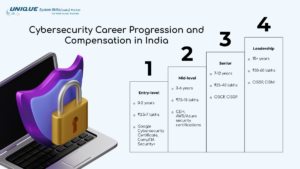
Ambition needs a map, so let us lay one out. At the entry level (0–2 years), freshers typically start between ₹3.5 and ₹7 lakhs, with some first-year offers closer to ₹4.2–5.5 lakhs. Reach mid-level (3–6 years) and pay scales up fast, often landing between ₹7.5 and ₹18 lakhs. Senior specialists (7–12 years) often cross ₹25–40 lakhs, and leadership roles at 15-plus years can reach ₹30–60 lakhs depending on the size of the company. Laid out like this, the growth curve in cybersecurity is clearly steeper than in many other IT fields.
Here is that ladder at a glance, along with the certificates that usually speed up each stage:
Cybersecurity Salary in India
Cybersecurity Salary in Indiacybersecurity salary in India Certificates are the clearest lever you control on this ladder. Certified professionals consistently earn 30–50% more than uncertified peers doing similar work. OSCP (Offensive Security Certified Professional) is highly valued for penetration testers because it proves real hands-on ability, not just book knowledge. CISSP and CISM matter most for people moving into leadership, often acting as the filter that decides who gets into the highest-paid group. CEH remains well respected, especially in banking, while AWS and Microsoft cloud certificates carry strong premiums for infrastructure-focused roles.
Take a mid-level analyst earning ₹9 lakhs who adds a CISSP. It is realistic for their next offer to land closer to ₹13–14 lakhs, simply because the certificate proves real, higher-level skill to hiring managers weighing cybersecurity salary in India benchmarks.

cybersecurity risk management salary
Why Unique System Skills Is the Ideal Training Partner
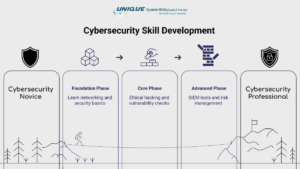
Structured, hands-on training is meant to close the gap in hands-on-training and soft-skills, present on our university education. Unique System Skills in Pune runs a step-by-step program built for exactly this.
Cybersecurity Skill Development
Additionally, small batch sizes mean personal attention on details that matter, like setting up a firewall or reading SIEM alerts correctly. Every phase ends with a real project instead of a multiple-choice test. In our own placement experience, graduates who finish all 3 phases and build a documented project portfolio typically enter the job market at the higher end of the entry-level range, rather than the lower end most freshers settle for. With full placement support and a network of over 100 hiring partners built over 17+ years, the program is built to turn learning directly into job offers. And, this is what decides your starting cybersecurity salary in India far more than any single exam score.
Conclusion: Your Path to a Strong Cybersecurity Salary in India
The numbers tell one clear story. The demand for skilled defenders is outpacing supply, certificates reliably lift pay by 30–50%, and specialising in cloud security or risk management brings some of the strongest premiums in Indian IT today. If you take away one thing from this guide, let it be this: the cybersecurity salary in India is not decided by luck or timing alone. It responds directly to the specialisation, certificate, and experience choices you make along the way.
Cybersecurity is increasingly seen as one of the most stable, future-proof careers in the country, and every stage of it offers a clear, learnable way to raise your value. Your first step does not need to be perfect; it just needs to be the right one for where you are standing today.

The Journey to a Higher Cybersecurity Salary
FAQ:-
What is the average cybersecurity salary in India?
It varies widely by role and experience, but a useful benchmark is the average cybersecurity analyst salary, which sits near ₹5.5 lakhs per year. This is more than triple the ₹1.7 lakh average for all bachelor’s-degree holders in India. Beyond analysts, pay ranges from ₹4–8 lakhs for network security engineers up to ₹17–22 lakhs for security architects.
What is the cybersecurity salary in India for freshers and experienced professionals?
Freshers (0–2 years) typically start between ₹3.5 and ₹7 lakhs a year, with some first-year offers closer to ₹4.2–5.5 lakhs. From there, it climbs steeply: mid-level professionals (3–6 years) earn ₹7.5–18 lakhs, senior specialists (7–12 years) often cross ₹25–40 lakhs, and leadership roles (15+ years) can reach ₹30–60 lakhs depending on the organisation’s scale.
What is the Google cybersecurity salary for cybersecurity professionals?
Google’s Cybersecurity Professional Certificate is an entry-level program built for people with zero prior experience, teaching Python, Linux, SQL, and SIEM tools over about six months. Its real value is unlocking the fresher-level cybersecurity salary in India (roughly ₹3.5–7 lakhs to start), especially when paired with CompTIA Security+ for a stronger dual credential.
What is the cybersecurity risk management salary in India?
Risk management, or GRC (Governance, Risk, and Compliance), has become one of the best-paid specialisations since India’s DPDP Act made data protection a legal obligation. GRC professionals and internal auditors are now in high demand across BFSI, telecom, and energy, commanding strong, well-compensated packages.
What is the average cybersecurity professional salary in India?
Averaged across the full career span, professional salaries range from ₹3.5–7 lakhs at entry level to ₹30–60 lakhs at the senior leadership tier, with certifications (CISSP, OSCP, CEH, CISM) adding a consistent 30–50% premium at any stage, and specialisations like cloud security or AI/ML security adding a similar premium on top of that.